
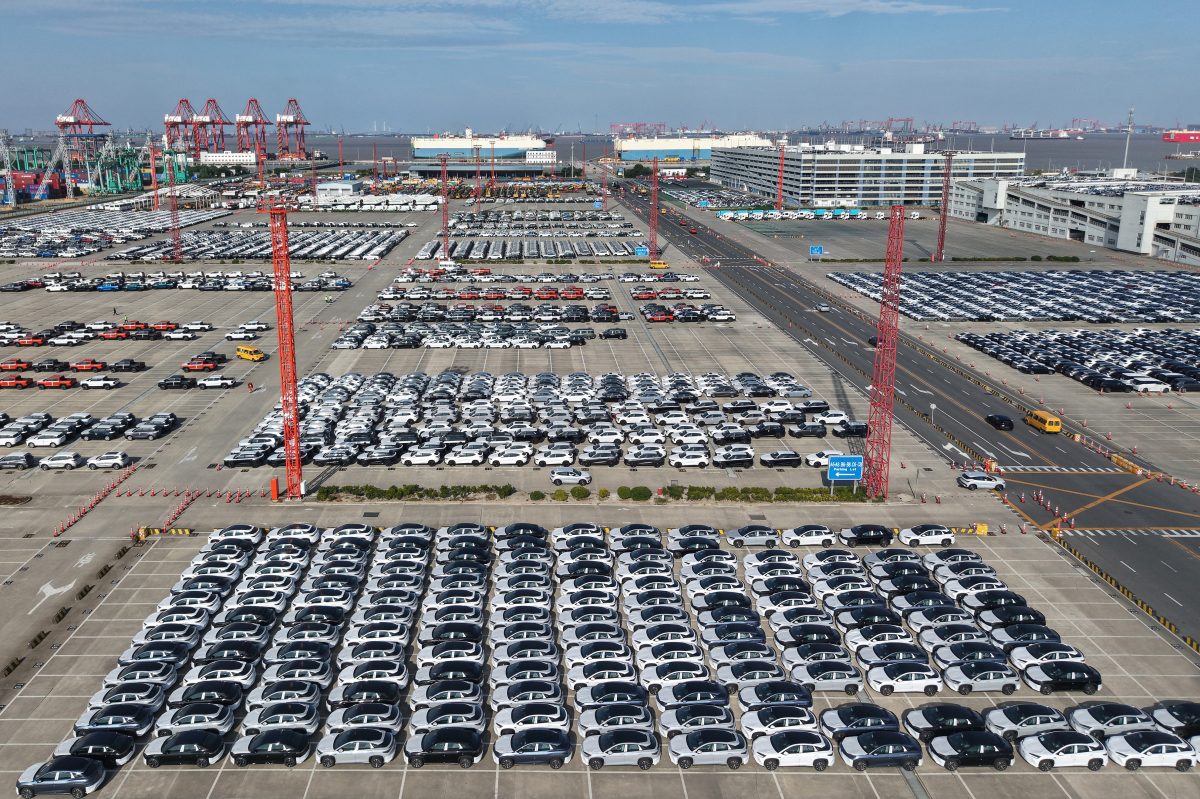
China's auto exports increased by 21% in 2025, the China Association of Automobile Manufacturers reported on Wednesday. The rise was fueled by electric vehicle shipments as domestic demand slowed.
Chinese manufacturers have intensified global sales, facing tough competition in the crowded home market. Last year, exports of new energy vehicles, including EVs and plug-in hybrids, doubled to 2.6 million units. Total vehicle exports exceeded 7 million units.
Exports are projected to grow further this year as automakers navigate a price war at home. Passenger car sales in China rose 6% to 24 million units for the full year, but December sales fell 18% year-on-year. Government trade-in subsidies, which had supported EV adoption, were reduced recently, dampening demand.
Deutsche Bank estimated that China's passenger vehicle exports will increase 13% year-on-year in 2026. The bank's economists noted that overseas markets offer higher profitability and faster growth for Chinese automakers.
On Monday, China and the European Union announced an agreement to resolve a standoff over China-made EV exports to the bloc. Analysts suggest this could boost Chinese EV exports to Europe.
Cui Dongshu, general secretary of the China Passenger Car Association, predicted that China's EV exports to the EU would grow by an average of around 20% annually from 2026 to 2028.
Stephen Chan, an associate director at S&P Global Ratings, said overseas markets currently contribute less than 10% of revenue for most Chinese automakers, though leaders like BYD see larger contributions. "We believe the (overseas) contribution will likely rise over the next two years as exports expand," he stated.
Key export destinations include Russia, Latin America, the Middle East, Europe, and Southeast Asia, which together made up about 70% of 2025 volumes, Chan added. Chinese automakers face higher barriers in wealthier markets like the U.S. and Canada due to steep EV tariffs.
BYD became the world's largest EV maker in 2025, surpassing Tesla. However, in December, BYD reported 420,398 deliveries for all vehicle types, down 18% from a year earlier.
Paul Gong, head of China Autos Research for UBS, said domestic passenger car sales will likely drop in 2026. S&P analysts noted that China's subsidies for new passenger cars are shifting from flat rates to a price-based system this year, increasing pressure on cheaper vehicle sales.
More than half of China's new passenger vehicle sales come from cars priced below 150,000 yuan ($21,510), S&P reported. "To secure sales, they (automakers) could target improving product features or subsiding consumers out of their own pockets," its analysts wrote.