
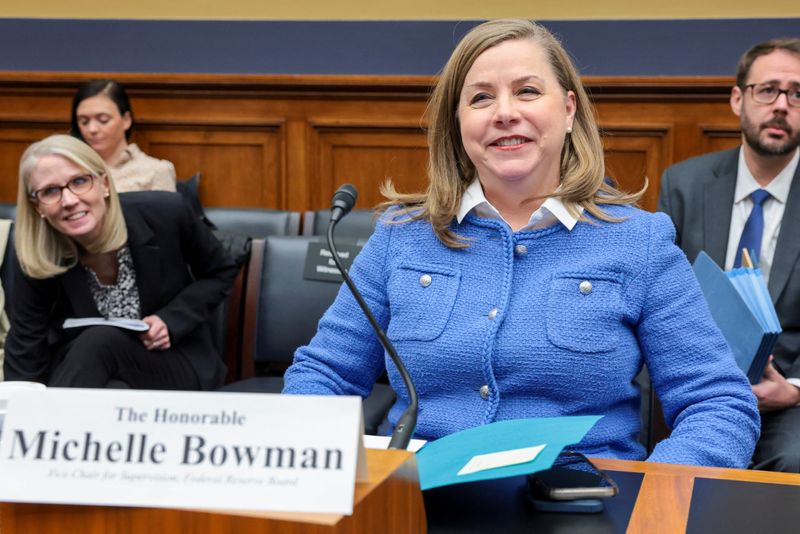
FOXBOROUGH, Massachusetts, Jan 16 (Reuters) - Federal Reserve Vice Chair for Supervision Michelle Bowman stated on Friday that the U.S. central bank must be prepared to reduce interest rates again if necessary, citing a job market that is fragile and could deteriorate rapidly.
"Without a clear and sustained improvement in labor market conditions, we should remain ready to adjust policy to bring it closer to neutral," Bowman said in prepared remarks for the Outlook 26: The New England Economic Forum in Foxborough, Massachusetts. She added that while monetary policy is not on a preset course, "we should also avoid signaling that we will pause" on further rate cuts "without identifying that conditions have changed."
Bowman noted her baseline expectation is for economic activity to continue expanding at a solid pace and the labor market to stabilize near full employment as monetary policy becomes less restrictive.
However, she said risks to the Fed's inflation and job mandates are uneven. Price pressures are likely to ease as the impact of trade tariffs diminishes, with underlying inflation close to the central bank's 2% target.
Meanwhile, the job market, currently near full employment, "has become increasingly more fragile and could continue to deteriorate in the coming months," Bowman stated. She warned conditions could change quickly, requiring the Fed to be nimble on policy.
Bowman described current monetary policy as "moderately restrictive" and said Fed officials should be forward-looking in setting interest rate policy. "We should rely on forecasts that are informed by a broad set of indicators and by ongoing engagement with businesses and communities across the country," she said.
Fed officials have signaled no urgency to act.
The Fed enters 2026 with policymakers expecting inflation pressures to moderate, the job market to stabilize, and growth to perform decently as uncertainty from President Donald Trump's erratic economic policies abates.
In the closing months of 2025, the Fed lowered its benchmark interest rate by three-quarters of a percentage point to the 3.50%-3.75% range. The central bank reduced short-term borrowing costs to support a weakening job market while maintaining enough restraint to address still-high inflation pressures.
At its December 9-10 meeting, Fed officials penciled in a single quarter-percentage-point rate cut for 2026. In comments early this year, they have signaled no urgency to act as they seek further evidence that inflation, which remains well over the 2% target, will abate.
As the Fed seeks data to justify another rate cut, it continues to face considerable pressure from Trump over lowering rates. The president will select a successor to Fed Chair Jerome Powell, whose term ends in May, and is expected to announce the outcome soon.
The conflict between the president and the Fed intensified recently with revelations that the central bank is being criminally targeted by the administration over costs associated with renovating the Fed's headquarters. Powell said the latest attack is about the Fed exercising independent judgment in setting rates.