
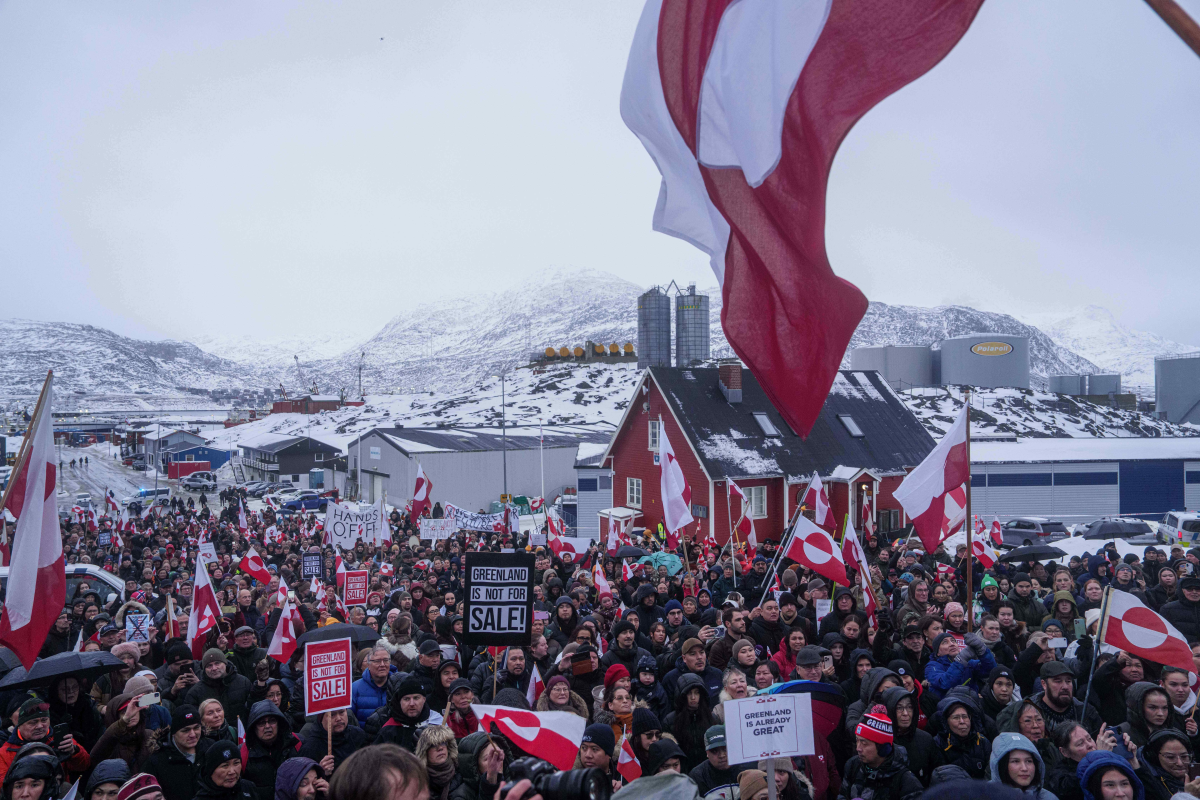
Global markets experienced volatility on Monday following President Donald Trump's announcement that he would impose tariffs on eight European nations. Trump vowed to place the tariffs until the United States is permitted to purchase Greenland.
Trump stated he will implement an additional 10% import tariff starting February 1 on goods from Denmark, Norway, Sweden, France, Germany, the Netherlands, Finland, and Britain. The tariff will increase to 25% on June 1 if no agreement is reached.
Major European Union states criticized the tariff threats on Sunday, describing them as blackmail over Greenland. France proposed responding with a series of previously untested economic countermeasures.
In currency markets, the euro strengthened 0.26% to $1.1628 after initially dropping to its lowest level since November. Investors broadly sold off the dollar, lifting other major currencies.
European stock futures declined, with EUROSTOXX 50 futures and DAX futures both falling 1.1%. Japan's Nikkei dropped 1% as risk-off sentiment spread.
"Hopes that the tariff situation has calmed down for this year have been dashed for now - and we find ourselves in the same situation as last spring," said Berenberg chief economist Holger Schmieding.
U.S. markets were closed on Monday for Martin Luther King Jr. Day, delaying Wall Street's reaction. U.S. stock futures were 0.7% lower in early Asian trading hours.
The dollar weakened broadly on Monday. The safe-haven yen and Swiss Franc gained, while Bitcoin fell nearly 3% to $92,602.64.
"While you would argue that the tariffs threaten Europe, in fact, it's actually the dollar that is bearing the brunt of it, because I think markets are pricing in increased political risk premia on the U.S. dollar," said Khoon Goh, head of Asia research at ANZ.
Capital Economics reported that the United Kingdom and Germany are most exposed to increased U.S. tariffs. The firm estimated a 10% tariff could reduce GDP in those economies by around 0.1%, while a 25% tariff could reduce output by 0.2%–0.3%.
European stocks remain near record highs. Germany's DAX and London's FTSE index have gained more than 3% this month, outperforming the S&P 500, which is up 1.3%.
European defence shares have jumped almost 15% this month and are expected to continue benefiting from geopolitical tensions. Concerns about Greenland were fueled by the U.S. seizure of Venezuela's Nicolas Maduro.
Denmark's crown currency has weakened but remains close to its central peg rate against the euro.
"The U.S.-EU trade war is back on," said Tina Fordham, geopolitical strategist and founder of Fordham Global Foresight.
Trump's announcement coincided with top officials from the EU and South American bloc Mercosur signing a free trade agreement.
The Greenland dispute represents one of several geopolitical tensions. Trump has also considered intervening in unrest in Iran, while a threat to indict Federal Reserve Chair Jerome Powell has raised concerns about the U.S. central bank's independence.
Safe-haven gold surged over 1% on Monday to a record $4,689.39 per ounce. The metal has gained nearly 8% in January after a 64% increase last year.
Given Trump's recent attacks on the Federal Reserve, an escalation with Europe could pressure the dollar if it adds to worries about U.S. policy credibility, said Peel Hunt chief economist Kallum Pickering.
"(This) could be amplified by a desire, especially among Europeans, to repatriate capital and shun U.S. assets, which may also pose downside risks to lofty U.S. tech valuations," he added.
The World Economic Forum's annual risk perception survey, released before its Davos meeting next week, identified economic confrontation between nations as the top concern, replacing armed conflict. Trump will attend the meeting.
A source close to French President Emmanuel Macron said he was pushing for activation of the "Anti-Coercion Instrument," which could limit U.S. access to public tenders, investments, banking activity, or trade in services where the U.S. has a surplus with the bloc.
"With the U.S. net international investment position at record negative extremes, the mutual inter-dependence of European-U.S. financial markets has never been higher," Deutsche Bank's global head of FX research George Saravelos said in a note.
"It is a weaponization of capital rather than trade flows that would by far be the most disruptive to markets."