
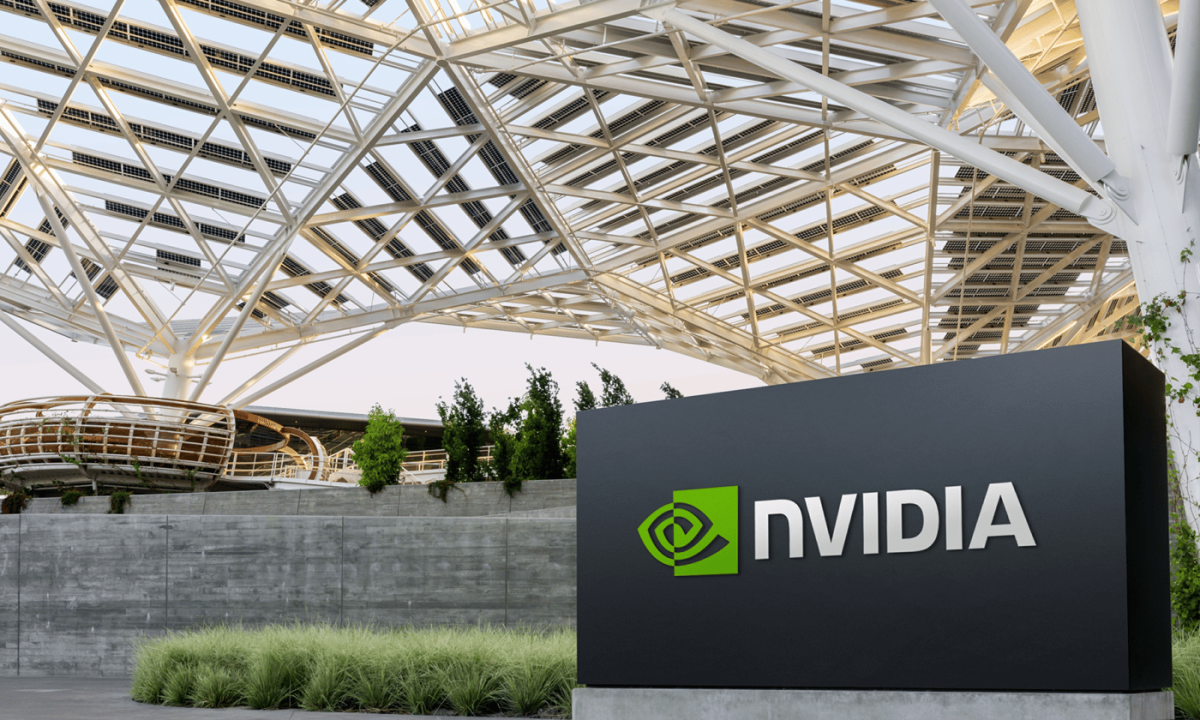
Nvidia's stock price has fallen by at least 27% in four of the last seven years. Each of these declines was only temporary. The factors behind the previous crashes also do not appear to be concerning now.
The company currently holds the world's largest market capitalization. Over the past decade, Nvidia's share price has increased by approximately 27,380%.
There is no strict definition of a stock crash, but many would consider a drop of 20% or more over a short period as one. Nvidia has experienced several such declines even during its remarkable 274-fold gain over the last ten years.
In 2019, Nvidia's share price sank 30% between early April and early June. This sell-off was partly due to the company lowering its revenue guidance amid lower-than-expected sales in data center and gaming markets.
Like most stocks, Nvidia crashed in the first quarter of 2020 during the early days of the COVID-19 pandemic. Between February 19, 2020, and March 16, 2020, Nvidia's shares plunged nearly 38%, a steeper decline than the S&P 500's sell-off of almost 30%.
Nvidia's stock plummeted roughly 27% between July 8, 2024, and August 7, 2024. Investors had welcomed the company's 10-for-1 stock split in June 2024, but excitement faded amid U.S. government restrictions on AI chip exports to China.
The most recent crash occurred last year. From January 6, 2025, to April 4, 2025, the GPU maker's share price dropped 37%. Concerns about the Trump administration's tariffs played a key role in this decline.
Nvidia's stock has crashed in four of the last seven years. A more gradual 60% sell-off during the first nine months of the 2022 bear market was not included in this count.
If recent history is any guide, Nvidia's stock is more likely than not to crash again in 2026. However, there is also good news for investors.
The factors behind Nvidia's steep declines in previous years do not appear to be present now. The data center market remains strong. There is reason for encouragement about Nvidia's ability to ship AI chips to China. The company has managed to navigate the Trump administration's trade policies. COVID-19 is not as serious a problem as it was in 2020.
Even if Nvidia's stock crashes, history shows that the decline should be only temporary. After the 2019 sell-off, Nvidia's stock finished the year up 76%. In 2020, the chipmaker's share price skyrocketed 291% despite the COVID-19 crash earlier in the year. In 2024, Nvidia's stock soared 171%. Last year, it delivered a 39% gain.
Demand for AI shows no signs of waning. Nvidia's Blackwell sales continue to rise. The company's new Rubin GPUs are on track to launch later this year. Adoption of agentic AI seems to be growing and could provide another tailwind for Nvidia. CEO Jensen Huang believes that "the transition to agentic AI and physical AI [AI that interacts with the physical world] will be revolutionary."
Nvidia's valuation is not nearly as scary as it has appeared in the past. The GPU maker's shares trade at a forward price-to-earnings ratio of 24.3. That multiple is not low, but it is not exorbitantly high.