
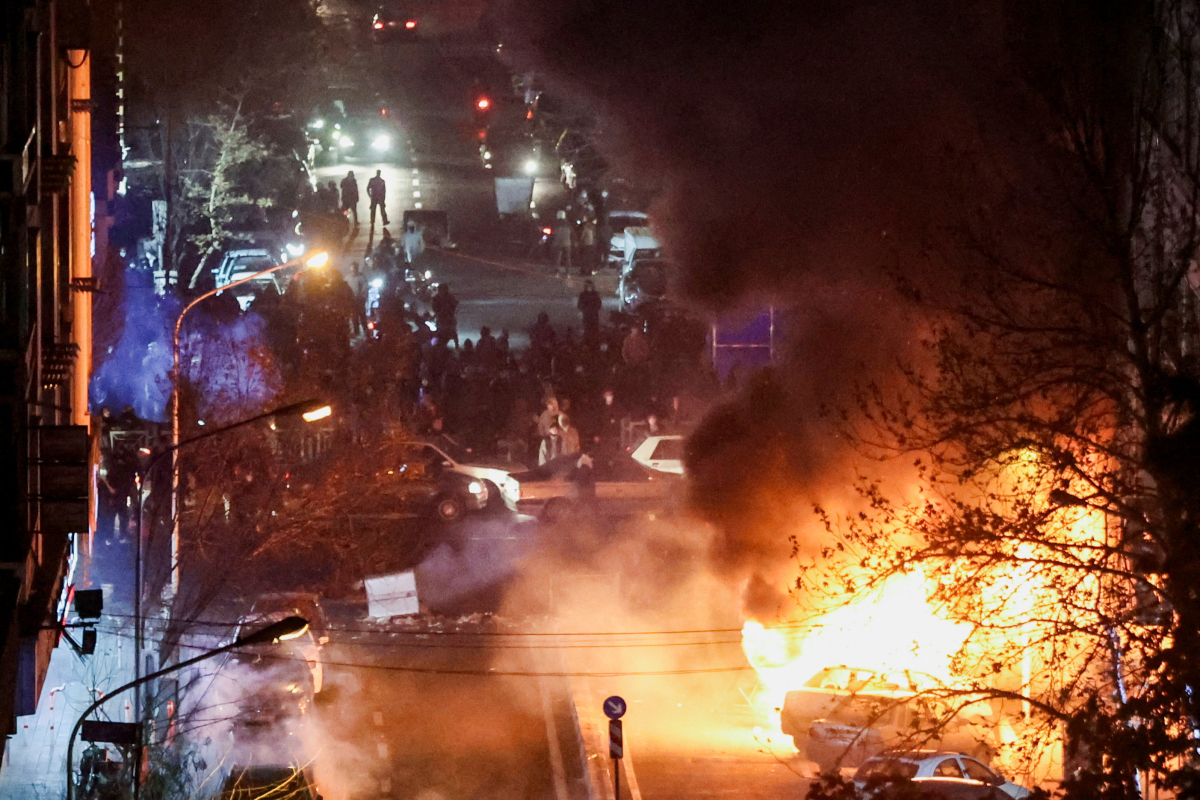
Oil prices climbed to their highest level in two months on Wednesday. Traders are adding a risk premium due to ongoing protests in Iran and statements from President Trump, who said the country's regime would "pay a big price."
Both Brent crude and West Texas Intermediate have increased more than 10% over the past five trading days. They now trade above $66.10 and $61.80 per barrel, respectively, marking the first time since October.
With tensions easing in Venezuela and shipments resuming, focus has shifted to Iran. Ben Cahill, director for energy markets and policy at the University of Texas Austin's Center for Energy and Environmental Systems Analysis, noted, "Iran's at the nerve center of the global oil market." He added, "If there's a physical supply disruption, the market will react in a big way."
Iran produces over 3 million barrels per day and exports about 1.5 million. It holds more than 200 billion barrels of proved reserves. The country also controls the Strait of Hormuz, a key passage for global oil flows. In 2024, an average of 20 million barrels per day moved through the strait.
On June 13, 2025, Israeli airstrikes hit Iranian targets, and Iran retaliated. Although the Strait of Hormuz remained open, Brent prices jumped roughly 7% in one day, from $69 to $74 per barrel.
Clay Seigle, a senior fellow at the Center for Strategic and International Studies, said, "In a situation of widespread upheaval, it's very likely that skilled workers are unable to actually get to [production and export facilities]." He continued, "Those two things together make me think that there is a strong chance of at least limited interruptions in production."
Cahill stated that a scenario where Iran's production and exports drop to near zero is unlikely but "worth considering." He warned, "If it happens quickly, there would be a huge shock to the market."
Jorge León, head of geopolitical analysis at Rystad Energy, pointed to the Iranian Revolution as an example. In 1978, protests grew against the monarchy. By February 1979, the Shah had fled, and Ruhollah Khomeini took power. Iran's production fell from over 5.7 million barrels per day before 1978 to 3.2 million in 1979 and 2.7 million in 1980.
Analysts say a loss of Iranian exports would hurt China, which bought over 80% of Iran's shipped crude in 2025. Much of this buying comes from smaller independent Chinese refiners known as "teapots." Iran's oil has been under strict U.S. sanctions since 2018.
If barrels from Venezuela and Iran are unavailable, Chinese refiners might turn to Russian oil or use domestic stockpiles. The Chinese government heavily stockpiled in 2025, likely for geopolitical insurance.
The Tehran regime faces pressure from the U.S. administration. Reports indicate the government's crackdown has killed thousands of protesters amid an internet blackout.
On Monday afternoon, President Trump posted on Truth Social, announcing a 25% tariff on any country doing business with Iran, effective immediately. The next morning, he said the Iranian regime would "pay a big price" and told protesters, "HELP IS ON ITS WAY." Oil prices rose after both posts.
Fundamentals may temper price increases. The International Energy Agency estimates a supply glut of around 3.6 million barrels per day. Given this oversupply, disruptions would need to be sustained and severe to keep prices rising.
"This is a very well-supplied oil market at the moment, and we've seen time and time again that geopolitical risks are just failing to register," Cahill said.
Rystad's León cautioned that traders shouldn't totally discount geopolitical risks. Data shows they are taking this view. Monday was the busiest day ever for trading in Brent crude call options, according to Intercontinental Exchange data compiled by Bloomberg. Implied volatility reached its highest level since the U.S. and Israel bombed Iran in June.
León stated, "Just the fact that there's civil unrest in a very important oil-producing country will probably add upside pressure."