
Oil prices have continued to climb without pause since the start of the year, moving from one geopolitical crisis to another. Just one week after U.S. intervention in Venezuela led to the capture of Nicolas Maduro, President Donald Trump has shifted focus to Iran. He has threatened a U.S. response to what he called the deadly suppression of mass protests against Iran's regime.
On Monday, oil settled at its highest level in a month. Market concerns center on potential supply disruptions in the Middle East if protests in Iran intensify and if some form of U.S. intervention prompts a reaction from Tehran.
Brent Crude reached $64 per barrel, a level not seen in 2026. The U.S. benchmark, WTI Crude, surpassed $59 a barrel. In early Asian trading on Tuesday, it approached $60, a price considered the safe breakeven point for most U.S. shale producers.
Prices may rise further as protests escalate in Iran and the U.S. President indicates he is considering a response to reports that hundreds of protesters have been killed by Iranian authorities.
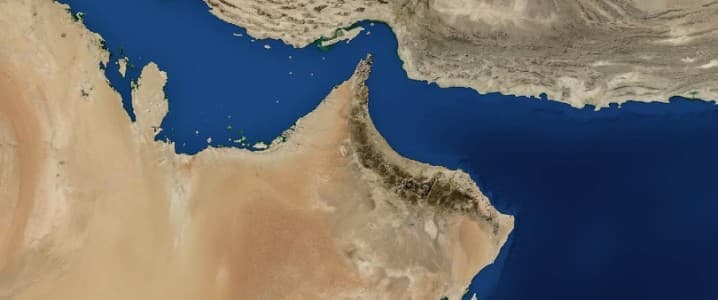
The ongoing unrest has revived concerns about possible oil supply disruptions in the Middle East. Traders are again considering the possibility, however unlikely, of Iran attempting to close the Strait of Hormuz. This narrow passage between Iran and Oman is the world's most critical oil transit chokepoint.
A closure of the Strait of Hormuz represents the oil market's greatest fear. Such an event could trigger oil price increases of $10 to $20 per barrel or more. The strait serves as the primary export route for all major Gulf oil producers, with few viable alternatives if it were blocked.
According to the U.S. Energy Information Administration, an average of 20 million barrels of oil per day flowed through the strait in 2024. This volume represents approximately 20% of global petroleum liquids consumption.
Only Saudi Arabia and the United Arab Emirates currently have operational pipelines that can bypass the Strait of Hormuz. Iran possesses the Goreh-Jask pipeline and the Jask export terminal on the Gulf of Oman as an alternative route, but EIA data shows it has rarely used this infrastructure in recent years.
The impact of a closure would extend beyond oil. Qatar's massive liquefied natural gas exports also transit the strait, meaning natural gas markets would be significantly affected.
The Strait of Hormuz has never been closed, indicating Iran has not acted on past threats. This also means the market has never experienced a disruption on this scale, making price impacts difficult to predict.
"The fear of a closure will cause the price of oil to rise a few dollars per barrel, but it is the complete closure of the Strait that can result in a $10 to $20 per barrel spike," Andy Lipow, president of Lipow Oil Associates, told CNBC this week.
Analysts generally view a complete strait closure as nearly impossible due to U.S. naval presence in the region. Some analysts see a higher probability of limited U.S. strikes on Iran, potentially similar to attacks on Iranian nuclear sites in June 2025.
Earlier this week, President Trump stated that Iran wants to negotiate. Meanwhile, Iranian Parliament Speaker Mohammad Baqer Qalibaf, a former commander of Iran's Revolutionary Guard, issued a warning to the United States.
"Let us be clear: in the case of an attack on Iran, the occupied territories (Israel) as well as all U.S. bases and ships will be our legitimate target," Qalibaf said.
Late Monday, President Trump announced a new diplomatic measure. "Effective immediately, any Country doing business with the Islamic Republic of Iran will pay a Tariff of 25% on any and all business being done with the United States of America," he stated.
Major economies conducting business with Iran include China, Russia, the United Arab Emirates, Turkey, and Brazil. China imports nearly all of Iran's oil exports at discounted prices and could be heavily impacted by the new tariff, even as the U.S. and China maintain a trade truce.
Two anonymous Defense Department officials told CBS News late Monday that the President has been briefed on a range of potential U.S. military and covert tools against Iran. These options reportedly extend beyond limited airstrikes and could include cyber operations and psychological campaigns aimed at disrupting Iranian command structures, communications, and state-run media.
It remains uncertain whether the U.S. will intervene militarily. It is also unclear how desperate Iranian rulers might become, or whether they would attempt to disrupt Middle East oil supply through attacks on regional infrastructure or posturing in the Strait of Hormuz, even as they crack down on domestic protests with increased force.
For now, the oil market is not pricing in a worst-case scenario disruption, and analysts suggest it likely should not.