
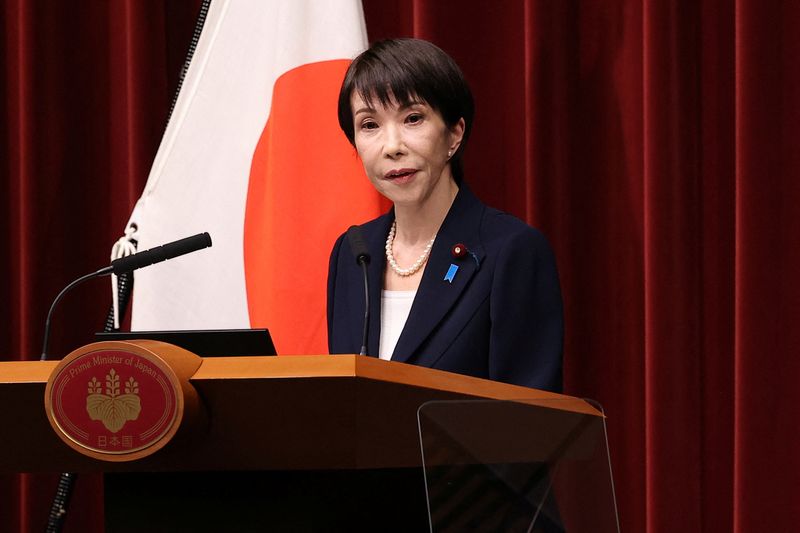
Japan's government bonds plunged on Tuesday, with yields on long-dated debt soaring to unprecedented levels. The selloff followed Prime Minister Sanae Takaichi's call for a snap election on Monday and campaign promises that included suspending a food levy for two years.
Dealers reported no buyers for 20-year, 30-year, and 40-year bonds, sending their yields to record highs. The sharp move drew comparisons to the 2022 collapse in British gilts.
"Markets are digesting the idea that all parties in Japan are in a race to see who can promise to spend more money," said Ales Koutny, head of international rates at Vanguard in London. "As we saw with the UK, markets at some point just have enough and start to demand much higher financing costs."
Ten-year yields jumped 18.5 basis points over two days, the steepest rise since Japan loosened a cap on benchmark bond yields in 2022. Twenty-year yields surged 28 basis points to above 3.4%, while 30-year and 40-year yields climbed by 40 basis points, breaking 3.8% and 4% respectively.
Tareck Horchani, head of prime brokerage dealing at Maybank Securities in Singapore, said, "Takaichi's election gamble and the talk of food tax cuts and fiscal expansion have changed the narrative very quickly." He noted Japan's 30-year yield is now 35 basis points higher than Germany's.
"The market is no longer treating super-long JGBs as an anchored asset, they're being repriced closer to global fiscal-risk curves," Horchani added. "This isn't just a technical selloff, it's a regime-style repricing of the long end, driven by politics, positioning, and a structural buyer vacuum."
The bond market decline accelerated after demand weakened at a 20-year bond auction on Tuesday morning. It coincided with a stock market pullback and prolonged pressure on the yen, fueled by fiscal concerns.
Inflation has exceeded the Bank of Japan's target for nearly four years. Takaichi's platform of increased spending has raised worries it could become uncontrolled and further depress the currency.
"Who is the natural buyer for all these JGBs that have been issued?" asked Ian Samson, a multi-asset portfolio manager at Fidelity International. "A portfolio manager like me looks at inflation still way above target, the Bank of Japan moving very, very slowly, an increasing lack of credible monetary or fiscal anchor and clearly aren't willing to step in."
Japan's chief cabinet secretary stated on Tuesday that the government was closely monitoring long-term interest rate movements.
The yen has been declining since Takaichi assumed leadership of the ruling party. Global bond markets also experienced turbulence on Tuesday, with selling in European and U.S. debts.
With three weeks remaining in the campaign, analysts believe a market stabilizer will be difficult to find and politicians are unlikely to take significant action to calm markets.
"The bottom line is no one wants to buy or catch the falling knife at this point," said Naka Matsuzawa, chief macro strategist at Nomura Securities in Tokyo. "There's no buyers on the level of the market."